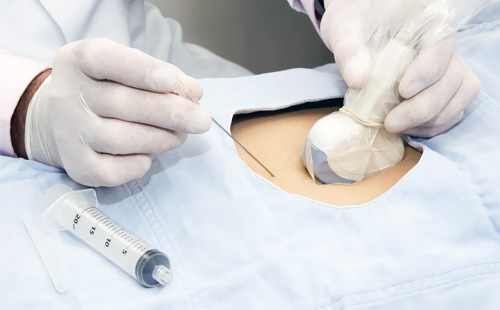
At the beginning of pregnancy, based on the SAT date, the fluid in the placenta containing the baby is defined as amniotic fluid. This amniotic fluid consists of the baby's cells.
Amniocentesis is the fluid taken in trace amounts by entering the uterus with a needle through the abdomen of the pregnant individual and then passing through the cord membrane to reach the amniotic fluid where the baby is located. Since this fluid consists of the baby's cells, it is possible to access the baby's entire genetics.
Many tests can be performed during pregnancy to examine the health status of the mother and baby. The most important of these is amniocentesis, which is performed to determine whether there is a genetic disorder in the baby.
Amniocentesis can diagnose and diagnose whether there is a numerical or structural disorder of the chromosomes or whether there is any genetic gene disorder.
One of the issues that pregnant women are most concerned about is whether there is a possibility of miscarriage with amniocentesis. Experienced specialist physicians, especially perinatologists, performing the amniocentesis procedure minimizes the risk.
While looking at the mother's abdomen in detail under ultrasound guidance, it is sufficient to take some of the fluid containing the baby with a fine needle. The most important thing is the correct date. It is the best time to do it within the 16th (~) 18th weeks of pregnancy.
Generally, doing it before the 16th week makes cell culture difficult due to the low number of rash cells of the baby in the amniotic fluid. After 18 weeks, the fluid decreases but the cell density and epithelial tissue increase. This is also challenging for long-term cell culture. The ideal date is 16 (~) 18 weeks.
Amniocentesis performed between these dates is known to have a miscarriage risk of less than 1% (between 0.6 (~) 0.9).
With 20 years of experience in our center, you can find out whether your baby is chromosomally healthy within 24 hours using the FISH method.
With the analysis of amniocentesis material, we can clearly detect chromosomal defects such as Down Syndrome, Edwards Syndrome, Patau syndrome, sex chromosome disorders, etc.
Trisomy 21 or Mongolism is a genetic disorder characterized by the presence of 3 of the 21st chromosome. Down Syndrome is the only autosomal trisomy in which a person can live longer than one year. It can be diagnosed during pregnancy by amniocentesis, CVS or cordocentesis. It occurs in every 750 (~) 1000 live births.
It is a chromosomal disorder that occurs when the 18th chromosome has 3 pieces. It is the most common autosomal anomaly after Down Syndrome. It has an incidence of one in every 5000 live births.
While the death of the baby occurs before the last month of pregnancy, 5% to 10% of the babies born can live over 1 year of age.
The majority of trisomy 18 patients have developmental delay and hand and foot anomalies.
It is a chromosomal disorder in which the 13th chromosome is 3. It occurs in one in 10,000 live births. Usually 70% of babies die in the 4th month after birth. Developmental delay is seen in the heart, digestive system and anterior part of the brain. It is usually seen in older pregnancies.
45 X is a syndrome that affects girls. It occurs when 1 of the sex chromosomes is missing. The external appearance, i.e. phenotype, appears female, but the sex cells do not develop. There is short stature. The function of the ovaries is inadequate. They are infertile individuals.
47 XXY only occurs in males. It is an excess of an X chromosome. Testosterone levels are low. Sex chromosomes are irregular. The external appearance phenotype may include long arms, a slab, and a cylindrical face.
To detect all these syndromes, CVS during pregnancy and FISH method give results within 3 days. After the preliminary diagnosis, it is necessary to wait for long-term cell culture. The full diagnosis is given in our center with chromosome analysis within 3 weeks after long-term cell culture.
Our center mainly provides services in the fields of genetic counseling, cytogenetics, molecular cytogenetics and molecular genetics. The problems of our patients who apply to our center, which are thought to have genetic causes, are helped by using up-to-date information and technology.
 Cytogenetic Tests
Chromosome disorders form an important category of genetic disease. Cytogenetic tests examine the number and morphology of chromosomes.
 Molecular Tests
Diseases that cause deterioration of human health and change the living order are diagnosed and detected through molecular tests.
 Molecular Cytogenetic Tests (Fish)
It is a discipline that expands the scope and increases the diagnostic value of routine chromosome analysis with the combined use of molecular biology and cytogenetic techniques.
 Cancer Scanning Tests
Diagnosis of cancer at an early stage greatly affects the success of cancer treatment. Many cancer tests are performed in our genetic diagnosis center.



 +90(312) 217 3226
We offer genetic analysis and clinical consultancy services at the highest technology and quality standards, using the most up-to-date scientific knowledge, diagnosis and treatment methods.
 Ankara Genetic Diagnosis CenterGenetics Laboratory


 Corporate
 Contact